Physical Address
304 North Cardinal St.
Dorchester Center, MA 02124
Physical Address
304 North Cardinal St.
Dorchester Center, MA 02124
SERVERACCESS.NET
SERVERACCESS.NET

What your paver patio needs beneath clay soil goes far deeper than most homeowners realize—and skipping these steps guarantees costly failure.
Clay soil base preparation for a paver patio requires excavating to a minimum depth that clears unstable material, installing compacted aggregate base in 3–4 inch lifts to 95% Modified Proctor density, and maintaining a 1–2% surface slope away from structures. Colorado Springs conditions intensify this requirement, as Pierre Shale and Dawson Formation claystone beneath neighborhoods like Broadmoor and Wolf Ranch produce documented ground displacement exceeding 7.5 cm following a single rainstorm. A compacted aggregate base is the load-distributing foundation layer installed beneath pavers to resist frost heave, soil expansion, and surface deflection across the finished patio surface.
Colorado Springs presents a compounding set of geotechnical conditions that distinguish paver installation here from most Front Range markets. Pierre Shale, which underlies the central and western portions of the city, contains bentonite interbeds capable of displacing soil 7.5–8 cm following a single significant rainfall event — movement that fractures rigid base layers and destabilizes surface courses regardless of compaction quality. The city’s 124 annual freeze-thaw cycles compound that instability, since a frost line reaching 38 inches at 50-year recurrence demands base depths that most standard residential installations don’t approach.
Pierre Shale, which underlies the central and western portions of Colorado Springs, contains bentonite interbeds with Plasticity Index values exceeding 35, producing documented ground displacement of 7.5–8 centimeters following a single rainstorm. This swell potential represents the defining geotechnical hazard for paver installations across much of El Paso County, where expansive clay minerals absorb moisture and exert upward pressure sufficient to fracture rigid base systems and displace surface courses. Freeze-thaw cycling compounds this risk: Colorado Springs averages 124 annual freeze-thaw cycles, among the highest of any major U.S. urban area, meaning a destabilized base faces repeated heave stress throughout the calendar year. Installations that omit engineered subgrade treatment on Pierre Shale terrain routinely fail within one to three seasons.
Colorado Springs carries a frost line depth of 38 inches at 50-year recurrence, based on NOAA KCOS Engineering Weather Data, establishing the minimum subgrade consideration depth for any structurally sound paver installation in El Paso County. This depth reflects an environment where 124 annual freeze-thaw cycles drive repeated volumetric expansion and contraction through the soil column, stressing base layers that lack sufficient depth, drainage, or compaction. On clay-bearing subgrades—particularly those underlain by Pierre Shale or Dawson Formation claystone lenses—frost penetration accelerates heave potential because saturated expansive soils expand both thermally and hygroscopically. Base systems that terminate above the effective frost influence zone remain vulnerable to differential movement, producing surface displacement and joint failure that compound with each successive winter season.
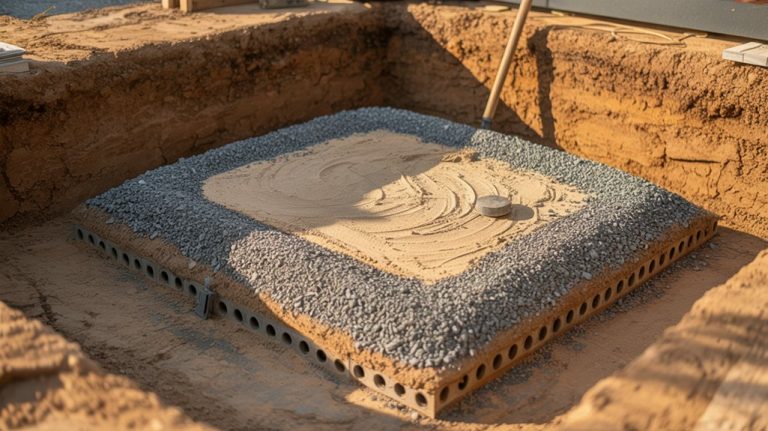
Where Pierre Shale or Dawson Formation claystone lenses lie beneath a proposed patio, standard base depths are functionally inadequate without first addressing what’s below them. Contractors typically overexcavate 12–18 inches beyond design grade, replacing displaced material with angular, well-graded structural fill that resists the lateral migration that expansive soils promote under load cycling. Each lift of fill, held to 3–4 inches, must reach 95% of Modified Proctor density per ASTM D1557 before the next layer proceeds — a sequencing requirement that directly determines whether the finished surface holds its plane through Colorado Springs’ 124 annual freeze-thaw cycles.
Pierre Shale, which underlies central and western Colorado Springs, contains bentonite interbeds capable of producing ground displacement of 7.5–8 cm following a single rainstorm. This expansive soil behavior makes standard base depths structurally inadequate without deliberate overexcavation and replacement with non-reactive structural fill. Where Pierre Shale or the interbedded gray claystone lenses of the Dawson Formation are encountered, overexcavation typically extends well below the frost line, which NOAA KCOS engineering weather data places at 38 inches at 50-year recurrence. Compacted Class 6 road base, placed and compacted to 95% of ASTM D1557 Modified Proctor density in 3–4 inch lifts, replaces the removed material and provides the dimensional stability that reactive native soils cannot sustain through Colorado Springs’ 124 annual freeze-thaw cycles.
ASTM D1557 Modified Proctor establishes the compaction benchmark for engineered paver base systems, requiring base material to reach 95% of maximum dry density across each 3–4 inch lift. This threshold matters acutely in Colorado Springs, where Pierre Shale and the interbedded gray claystone lenses of the Dawson Formation generate documented ground displacement of 7.5–8 cm from a single rainstorm — displacement that under-compacted base material cannot resist. Achieving 95% Modified Proctor density eliminates the interparticle void space that allows moisture infiltration and subsequent frost heave across the city’s 124 annual freeze-thaw cycles. Nuclear density gauge testing performed during placement, rather than after full base installation, allows each lift to be verified and corrected before the next layer obscures the compaction record.
Drainage design in Colorado Springs carries consequences that surface slope alone can’t resolve, particularly where HSG D soils in the Broadmoor and Kissing Camels corridors inhibit infiltration and redirect water laterally beneath the base. Permeable paver systems, tested under ASTM C1782 and C1781, offer a pressure-relief mechanism in moderate-drainage zones, though their effectiveness depends heavily on whether underlying soils can accept the routed flow without mobilizing expansive clay lenses. Edge restraint systems face their own set of demands, since the city’s 124 annual freeze-thaw cycles generate lateral displacement forces that compromise confinement if spike spacing, material selection, and embedment depth aren’t calibrated to actual frost-line exposure.
Permeable paver systems tested under ASTM C1782 and ASTM C1781 provide a code-recognized infiltration pathway that reduces surface runoff volume in a climate where NOAA climate normals record only 15.91 inches of annual precipitation but freeze-thaw cycling occurs approximately 124 times per year. That cycling frequency subjects open-graded base aggregates to repeated displacement, making proper compaction and bedding gradation critical to long-term infiltration performance. IRC site-drainage provisions require a minimum 1–2% surface slope away from structures, a threshold that applies equally to permeable and conventional systems. In HSG D soils prevalent across the Broadmoor and Kissing Camels corridors, where native permeability is lowest, permeable pavers alone cannot compensate for underlying clay without supplemental lateral drainage infrastructure integrated into the base design.
Lateral edge restraint failure under cyclic frost heave loading allows paver fields to spread horizontally, progressively collapsing the bedding sand plane and eliminating the 1–2% surface slope required under IRC site-drainage provisions. Colorado Springs averages 124 freeze-thaw cycles annually, a frequency that generates cumulative lateral pressure sufficient to displace unrestrained perimeter courses over a single seasonal cycle. Where Pierre Shale underlies installations across the Broadmoor and Kissing Camels corridors, vertical ground displacement documented at 7.5–8 cm following a single rainstorm compounds that lateral loading, demanding that edge restraint systems be staked at depths reaching the compacted base layer. Spike spacing and embedment depth must account for 95% Modified Proctor compaction per ASTM D1557 to guarantee anchors seat into a stable bearing zone rather than loose subgrade material.
Homeowners planning paver patios in Colorado Springs tend to raise the same practical questions: how deep the base should go in clay-heavy soils, whether Pierre Shale beneath central and western neighborhoods shortens a patio’s functional lifespan, which ASTM standards govern base compaction, and when a permit from the Pikes Peak Regional Building Department becomes mandatory. The answers depend considerably on site-specific conditions — soil classification, frost exposure, and whether the project includes any retaining element exceeding four feet. What follows addresses each question directly, grounded in local geotechnical realities and the code framework that applies throughout El Paso County.
In Colorado Springs clay soils, paver base depth typically ranges from 6 to 8 inches of compacted aggregate, though Pierre Shale and Dawson Formation sites with high-swell claystone lenses may warrant 10 to 12 inches. Base material must be compacted to 95% of ASTM D1557 Modified Proctor in 3 to 4 inch lifts. Frost line depth reaches 38 inches at 50-year recurrence, making proper drainage and compaction critical throughout neighborhoods like Broadmoor and Wolf Ranch.
Pierre Shale dramatically reduces paver patio longevity when base preparation fails to account for its expansive bentonite interbeds, which can displace soil 7.5–8 cm after a single rainstorm. Displacement severity depends on bentonite interbed thickness, which ranges from 1–3 inches and locally reaches 8 inches. Backyard Paradiso addresses this hazard through engineered base systems calibrated to site-specific geotechnical conditions across affected Colorado Springs neighborhoods.
Base compaction for paver patio installations is governed by ASTM D1557, the Modified Proctor standard, requiring compaction to 95% of maximum dry density applied in 3–4 inch lifts. Pierre Shale and Dawson Formation soils in Colorado Springs demand particular attention to moisture content during compaction due to high swell potential. Backyard Paradiso applies these standards across all Colorado Springs service areas, including high-clay corridors like Broadmoor and Kissing Camels.
Most paver patios in Colorado Springs do not require a permit, but retaining walls exceeding four feet in height trigger mandatory permitting through the Pikes Peak Regional Building Department. PPRBD also requires a site-specific soils report on-site at first inspection for all residential construction. Projects involving significant grade changes near Pierre Shale zones warrant particular attention to these thresholds.
Colorado Springs’ 124 annual freeze-thaw cycles, Pierre Shale swell potential, and 38-inch frost line depth at 50-year recurrence collectively determine whether a paver base performs over decades or begins failing within the first few winters. Backyard Paradiso’s base preparation work reflects direct familiarity with these conditions, built through paver patio installations across neighborhoods where soil profiles and drainage classifications vary sharply from one site to the next. Consultations are available by appointment for properties throughout Flying Horse, Briargate, Wolf Ranch, Broadmoor, Black Forest, and surrounding communities in the Pikes Peak region. A base system engineered to the actual geotechnical conditions of a given site — accounting for HSG classification, proximity to Pierre Shale or Dawson Formation claystone, and ASTM D1557 compaction standards — represents recoverable value that extends the functional life of the installation and supports long-term property performance.