Physical Address
304 North Cardinal St.
Dorchester Center, MA 02124
Physical Address
304 North Cardinal St.
Dorchester Center, MA 02124
SERVERACCESS.NET
SERVERACCESS.NET
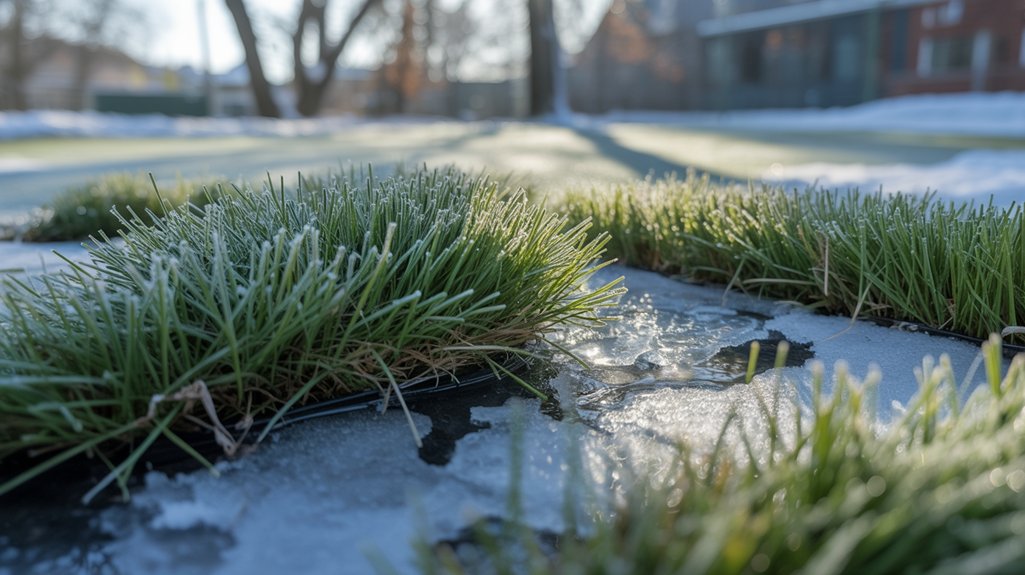
Jersey's brutal freeze-thaw cycles test artificial grass in ways most homeowners never anticipate—discover what determines whether your installation survives.
Artificial grass performs reliably through New Jersey freeze-thaw seasons when installed over a properly compacted aggregate base designed to accommodate Bergen County’s 70-plus annual freeze-thaw cycles. Performance depends on base depth of three to four inches compacted to ASTM D1557 standards, accounting for HSG C Boonton series soils that drain at only 0.05–0.15 inches per hour. Artificial grass is a synthetic polyethylene fiber surface system engineered to remain dimensionally stable through repeated freezing and thawing without heaving, cracking, or losing drainage function.
Bergen County’s dominant Boonton series — a glacially derived, HSG C loam with infiltration rates between 0.05 and 0.15 inches per hour — retains enough moisture near grade to make freeze-thaw heave a structural concern rather than a cosmetic one. Where perched water tables develop over dense till or diabase substrata, that moisture load compounds through wet-spring saturation cycles, subjecting any inadequately drained base to repeated volumetric expansion against compacted aggregate. The 36-inch frost line established under the 2021 NJ Residential Code informs how base drainage geometry must be oriented to intercept and redirect subsurface water before it reaches the compaction zone, where ASTM D1557 targets of 90–95% Modified Proctor density are otherwise sufficient to resist the mechanical stress of 70-plus annual freeze-thaw cycles.
The dominant residential soil across Bergen County’s estate corridor is the Boonton series, classified as Hydrologic Soil Group C with a measured infiltration rate of 0.05 to 0.15 inches per hour under NRCS soil survey methodology. This glacial till-derived material — dense, acidic, and laden with basalt, sandstone, and shale fragments — drains slowly enough that subsurface water accumulates beneath installed base layers rather than dispersing laterally or vertically during storm events. Perched water tables compound the condition on upland sites where impermeable diabase or dense till substrata trap seasonal infiltration. With Bergen County logging more than 70 freeze-thaw cycles annually, standing water trapped within or beneath a base layer becomes a repeated expansion-contraction force that degrades compaction, displaces aggregate, and produces surface deformation across the turf plane.
The 2021 New Jersey Residential Code, Section R403.1.4, establishes a 36-inch frost line depth for the state — a structural threshold that directly governs base drainage geometry in artificial grass installations across Bergen County’s estate corridor. When freeze-thaw action penetrates to that depth, any water retained within or beneath a compacted aggregate base undergoes volumetric expansion of approximately nine percent, a force sufficient to fracture compaction bonds and displace infill-supporting aggregate. ASTM D1557 Modified Proctor compaction standards require base material to reach 90 to 95 percent of maximum dry density, installed in compacted lifts, to resist that cyclic displacement. Bergen County’s 70-plus annual freeze-thaw cycles mean that base layers failing to achieve ASTM D1557 thresholds are subject to cumulative degradation across successive winters rather than isolated storm events.
De-icing salt applied along estate driveways and walkways introduces chloride exposure that accelerates fiber degradation in artificial grass installations where polyethylene pile sits within spray or runoff range. Polyethylene’s inherent resistance to chloride absorption makes it the fiber of choice for Bergen County’s corridor properties, though UV degradation compounds salt stress over successive winters, particularly on south-facing slopes where solar exposure is sustained. ASTM F1551 provides the performance characterization framework that distinguishes fiber systems capable of tolerating this compounded stress from those that’ll fail prematurely under the corridor’s specific conditions.
Polyethylene fiber used in residential artificial grass installations is susceptible to chloride-induced surface degradation when exposed to repeated de-icing salt application near driveways and walks. Along the Bergen County estate corridor, where nor’easter events averaging 18–24 inches occur every few winters according to NOAA regional snowfall records, chloride contact is a seasonal constant rather than an isolated event. Sodium and calcium chloride compounds penetrate fiber surface layers through repeated wet-dry cycling, accelerating UV-initiated oxidation and reducing tensile integrity over time. For installations in Alpine, Tenafly, and Englewood Cliffs — where Palisades-adjacent drainage geometry concentrates meltwater runoff — fiber and infill selection must account for compounded chloride and freeze-thaw stress as a paired degradation mechanism rather than treating each in isolation.
ASTM F1551 establishes the thorough performance characterization framework against which synthetic turf fiber systems are evaluated for tensile strength retention, colorfastness, and resistance to accelerated weathering under combined mechanical and chemical stress. For installations across the Bergen County estate corridor, this framework carries direct relevance because de-icing salt exposure and 70-plus annual freeze-thaw cycles — as recorded at Teterboro Airport under NOAA 1991–2020 climate normals — operate simultaneously rather than sequentially on fiber and infill systems. Synthetic Turf Council installation standards further specify compaction tolerances and drainage geometry that govern whether base layers accommodate freeze-thaw heave without transmitting differential stress upward into the fiber layer. In Alpine, Englewood Cliffs, and Tenafly, where Palisades diabase bedrock presents HSG D infiltration conditions, meltwater concentrating at grade amplifies chloride contact duration, making ASTM F1551 weathering resistance thresholds a baseline specification requirement rather than an optional performance benchmark.
Estate-corridor installations that disturb 5,000 square feet or more trigger mandatory certification through the Bergen County Soil Conservation District under the NJ Soil Erosion and Sediment Control Act — a threshold that larger residential projects in Alpine, Franklin Lakes, or Upper Saddle River can reach without difficulty. The NJDEP Stormwater Management Rule (N.J.A.C. 7:8, effective March 2, 2021) adds a parallel compliance layer wherever qualifying disturbances alter post-construction runoff characteristics, which artificial grass installations frequently do by replacing permeable vegetated cover with a semi-impervious engineered surface. Properties adjacent to the Saddle River face the most constrained conditions: the river’s Category One designation under N.J.A.C. 7:9B extends a 300-foot riparian buffer along most of its corridor length, limiting the scope, grading, and drainage engineering that any installation within that envelope can lawfully incorporate.
The Bergen County Soil Conservation District requires project certification under the New Jersey Soil Erosion and Sediment Control Act for any land disturbance reaching 5,000 square feet or more. For estate-scale artificial grass installations across the Alpine, Saddle River, and Franklin Lakes corridor, this threshold is frequently reached when rear lawn conversion, side yards, and staging areas are calculated as a single disturbed area. Projects that also involve grading or drainage improvements near the Saddle River must account for the Category One surface water designation under N.J.A.C. 7:9B, which imposes a 300-foot riparian buffer along most of that corridor. The NJDEP Stormwater Management Rule, N.J.A.C. 7:8, effective March 2, 2021, applies independently to qualifying post-construction disturbances, potentially triggering separate review alongside BCSCD certification.
The Saddle River carries a Category One designation under N.J.A.C. 7:9B, imposing a 300-foot riparian buffer along most of its corridor length that restricts land disturbance on properties in Ridgewood, Saddle River, and Upper Saddle River. Estate installations within or adjacent to that buffer must demonstrate that impervious surface additions do not degrade surface water quality, a requirement that intersects directly with the NJDEP Stormwater Management Rule under N.J.A.C. 7:8, effective March 2, 2021. Artificial grass, classified as an impervious or semi-impervious surface depending on infill permeability and base design, can trigger post-construction stormwater controls independent of any BCSCD certification requirement. Projects disturbing land near the Saddle River floodplain — where seasonal high water tables and Dunellen series HSG B soils already complicate base drainage — face concurrent review tracks that must be coordinated before installation proceeds.
Bergen County’s freeze-thaw regime — averaging 70-plus cycles annually — defines the principal mechanical stress that any artificial grass base must sustain across the estate corridor. Polyethylene fiber tolerates repeated frost heave when the compacted base beneath it maintains 90–95% Modified Proctor density; without that structural integrity, differential movement at the surface becomes inevitable. Several questions about de-icing salt exposure near drives, BCSCD certification thresholds, riparian setbacks, and correct base depth in glacial till conditions come up consistently among property owners planning installations.
Bergen County artificial grass base installations endure more than 70 freeze-thaw cycles annually. Boonton series HSG C soils — dominant across the corridor — slow drainage and amplify frost heave stress on compacted aggregate base layers. Proper base depth and lift compaction to ASTM D1557 standards directly determine long-term structural integrity through repeated seasonal cycling.
De-icing salt poses measurable risk to artificial grass fiber and infill when repeated exposure occurs near driveways and walks. Polyethylene fiber itself resists direct salt degradation reasonably well, but chloride infiltration can destabilize infill media and accelerate base-layer compaction loss through repeated freeze-thaw cycling. Bergen County’s 70-plus annual freeze-thaw cycles amplify this concern, making salt-resistant infill selection a material specification priority for corridor estate installations.
Bergen County Soil Conservation District approval is required when a project disturbs 5,000 square feet or more of land under the NJ Soil Erosion and Sediment Control Act. Most residential artificial grass installations fall below that threshold, exempting them from BCSCD certification. Larger estate projects — particularly along Alpine’s Palisades bluff line or Franklin Lakes’ Urban Farms corridor — should be evaluated against that acreage trigger before work begins.
Bergen County artificial grass installations require 3–4 inches of compacted aggregate base, installed in lifts to 90–95% of Modified Proctor density per ASTM D1557. Boonton series glacial till, classified as HSG C with infiltration rates of 0.05–0.15 in/hr, demands careful base grading to address slow drainage. Bergen County’s 70-plus annual freeze-thaw cycles make proper compaction and lift sequencing the primary defense against base heave and surface deformation.
Along the Palisades bluff estates of Alpine and Englewood Cliffs, where HSG D soils over diabase bedrock eliminate effective natural infiltration and lot-scale drainage geometry becomes a primary design constraint, freeze-thaw performance is inseparable from base engineering. Backyard Paradiso installs artificial grass across these corridors with base specifications calibrated to Bergen County’s 70-plus annual freeze-thaw cycles, compacted in lifts to Modified Proctor standards that sustain grade stability through successive nor’easter seasons. Consultations are available by appointment for estate properties throughout the corridor. Installations are assessed against long-term functional square footage equivalence and resale recovery — particularly relevant on properties where usable outdoor area directly reflects maintained surface condition across seasonal extremes. Backyard Paradiso also serves Franklin Lakes, Wyckoff, Ridgewood, Saddle River, and Upper Saddle River, extending the same site-specific base and drainage analysis to each municipality’s distinct soil profile and regulatory context.